Branding is not just for big companies with big budgets. Every business already has a brand — it is the impression people form when they see your logo, visit your website, open your packaging or read your messages. The question is whether that impression is deliberate and consistent, or accidental and confusing. Good small business branding makes you look established, helps customers remember you and makes every marketing effort work harder.
This guide covers the full process in plain language: defining your brand, designing a logo, choosing colours and fonts, creating a brand voice, building a simple brand kit and applying it across your website, social media, print and packaging.
What Is Branding for a Small Business?
Branding is the combination of how your business looks, sounds and feels to customers. It includes visual elements such as your logo and colours, and non-visual elements such as your tone of voice, values and customer experience.
Brand vs logo
A logo is one part of your brand. Your brand is the whole experience — from the first ad a customer sees to the way you answer their questions after a sale.
Why branding matters
- Recognition — consistent visuals make you memorable
- Trust — a professional, consistent brand signals a reliable business
- Value — strong brands can charge more than unknown competitors
- Efficiency — clear brand rules make new marketing materials faster to create
Step 1: Define Your Brand Foundations
Before designing anything, get clear on who you are and who you serve. This makes design decisions easier and more meaningful.
Your purpose and promise
Write one or two sentences describing what you do, for whom, and the main benefit you deliver. For example: “We build professional websites and print branded products for small businesses, so they can look as good as big competitors.”
Your target customers
Describe your ideal customers: their industry, size, location, problems and goals. A brand that tries to appeal to everyone usually appeals strongly to no one.
Questions to answer
- What problems do your customers want solved?
- What do they value most — price, speed, quality or service?
- Where do they spend time online?
- What words do they use to describe their needs?
Your personality
Choose three to five words that describe how your brand should feel, such as “friendly, expert, modern” or “premium, calm, trustworthy”. These words guide every design and writing decision.
Your competitors
Review how competitors present themselves. Look for gaps — perhaps everyone looks corporate and cold, giving you room to be warmer and more personal.
Step 2: Design a Professional Logo
What makes a good logo?
- Simple — recognisable at a glance
- Scalable — clear on a favicon and on a large sign
- Versatile — works in colour, one colour, and on light and dark backgrounds
- Relevant — fits your industry and personality
- Distinctive — different from competitors
Types of logos
Wordmark
Your business name in a distinctive font. Clean and easy to remember.
Lettermark
Initials or a monogram — useful for long business names.
Icon or symbol
A graphic mark that represents your business. Often combined with the name.
Combination mark
An icon plus the business name. The most flexible option for small businesses.
Emblem
Text inside a shape or badge — classic and suitable for some industries, though harder to use small.
Logo variations you need
- Primary logo (full colour)
- Horizontal and stacked versions
- Icon-only version for social media and favicons
- One-colour versions for dark and light backgrounds
File formats
Keep vector files (AI, EPS, SVG, PDF) for printing and PNG files with transparent backgrounds for digital use.
Step 3: Choose Your Brand Colours
How colour affects perception
Colours carry associations, although meanings vary by culture and context. Blues often suggest trust and professionalism, greens suggest growth and nature, reds and oranges suggest energy, and dark neutrals suggest premium quality.
Build a simple palette
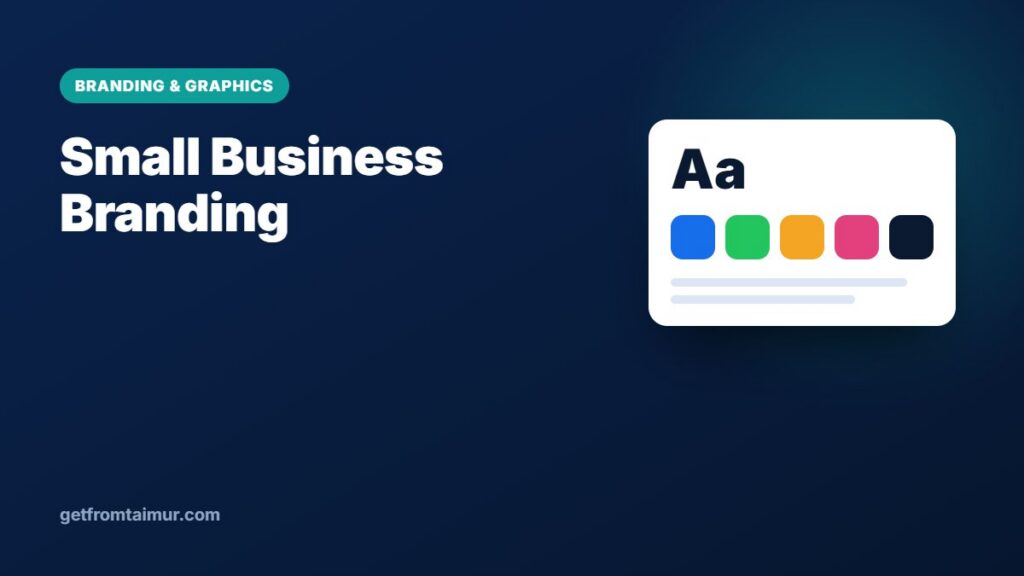
- Primary colour — your main brand colour
- Secondary colour — supports the primary
- Accent colour — for buttons and highlights
- Neutrals — dark text, light backgrounds and greys
Record colour codes
Document each colour in HEX (web), RGB (screens), CMYK (print) and Pantone if needed. This keeps your website, print and packaging consistent.
Check accessibility
Text must have enough contrast against its background to be readable. The Web Content Accessibility Guidelines (WCAG) provide contrast recommendations.
Step 4: Select Your Brand Fonts
Font categories
Serif
Small strokes at the ends of letters. Traditional, trustworthy and elegant.
Sans-serif
Clean letters without strokes. Modern, clear and great on screens.
Script and display
Decorative fonts for headlines or logos. Use sparingly.
Pair two fonts
Choose one font for headings and one for body text — or one versatile family with several weights. Too many fonts look messy.
Web-friendly fonts
Free libraries such as Google Fonts offer high-quality fonts that work well on websites and in print.
Step 5: Define Your Brand Voice
What is brand voice?
Brand voice is how your business sounds in writing — on your website, social media, emails and packaging.
Voice guidelines
- Formal or conversational?
- Technical or simple?
- Serious or playful?
- Which words do you use — and which do you avoid?
Example
“We speak like a helpful expert friend: clear, confident and jargon-free. We explain prices and processes openly.”
Step 6: Create Imagery and Graphic Style
Photography
Use real photos of your products, team and workplace when possible. Keep lighting, backgrounds and editing style consistent.
Illustrations and icons
Choose one icon style — line, filled or duotone — and use it everywhere. Mixed styles look unprofessional.
Patterns and shapes
Repeated shapes, gradients or patterns can become recognisable brand elements on social posts, packaging and print.
Step 7: Build a Simple Brand Kit
A brand kit (or brand guidelines) is a short document that explains how to use your brand. It helps designers, printers, staff and freelancers produce consistent work.
What to include
- Logo versions and minimum sizes
- Clear space around the logo
- Colour palette with codes
- Fonts and sizes
- Voice and tone guidelines
- Photo and icon style examples
- Examples of correct and incorrect use
Keep it short
For most small businesses, a few clear pages is enough.
Step 8: Apply Your Brand Everywhere
Website
Your website is often your most visible brand asset. Use your colours, fonts, logo and voice consistently across every page. Set global colours and fonts in your website builder so updates stay consistent.
Social media
Use your icon logo as the profile picture, a branded cover image and consistent post templates.
Business cards and stationery
Business cards, letterheads, invoices and email signatures should all use the same logo, colours and fonts.
Packaging and labels
Branded boxes, stickers, tags and inserts turn deliveries into memorable experiences.
Merchandise and uniforms
Branded T-shirts, caps and tote bags help your team look professional and promote your business.
Printing tip
Provide printers with vector logos and CMYK or Pantone colour codes for accurate results.
Branding on a Small Budget
Prioritise
Start with a strong logo, colour palette, fonts and a professional website. Add packaging and merchandise later.
Use templates wisely
Templates save time, but customise them with your colours, fonts and imagery so you do not look like everyone else.
Be consistent
Consistency matters more than expensive design. A simple brand used consistently beats a complex brand used randomly.
Common Branding Mistakes
- Changing logos and colours frequently
- Using too many fonts and colours
- Copying competitors too closely
- Low-resolution logos on print and signage
- Ignoring how the brand looks on mobile
- A brand voice that changes from channel to channel
When to Rebrand
Signs it is time
- Your business has changed direction or target market
- Your brand looks outdated compared with competitors
- Your brand is inconsistent and confusing
- You are moving into a more premium market
Refresh or rebrand?
A refresh updates colours, fonts and logo details while keeping recognition. A full rebrand changes name, logo and identity — a bigger project.
Branding Examples by Business Type
Different industries call for different brand personalities. Here are practical directions for common small business types.
Service businesses (consultants, agencies, clinics)
Trust and expertise are key. Clean layouts, calm colours such as blues and greens, readable sans-serif fonts and real photos of the team work well. The voice should be clear, confident and helpful.
Clothing and lifestyle brands
Personality matters most. Bold typography, distinctive colours, strong photography and a recognisable logo mark help products stand out on social media. Packaging and labels are major brand touchpoints.
Food and cafés
Warm colours, friendly fonts, appetising photography and a welcoming voice. Branding appears on signage, menus, cups, bags and delivery packaging.
Manufacturing and B2B suppliers
Professionalism and reliability. A strong wordmark, structured layouts, technical clarity and consistent documents such as catalogues and quotations build buyer confidence.
Online stores
Consistency across the website, product photos, emails and packaging creates a seamless experience. Brand colours should guide buttons and highlights without overwhelming product images.
Avoid trend-chasing
Design trends come and go. Build your brand on clarity and your business values, then refresh details gradually over time.
Brand Touchpoints Checklist
Every place a customer meets your business is a brand touchpoint. Review each one for consistency.
Digital
- Website and favicon
- Google Business Profile
- Social media profiles, covers and posts
- Email signatures and newsletters
- Online ads and marketplace listings
- WhatsApp business profile and messages
- Business cards and letterheads
- Invoices, quotations and receipts
- Flyers, brochures and catalogues
- Stickers and labels
Physical
- Shop signage and interior
- Uniforms and T-shirts
- Packaging, boxes and bags
- Vehicles and event stands
Experience
- How phone calls and messages are answered
- Delivery and unboxing
- After-sales support and follow-up
Branding and Your Website
Your website is where branding, marketing and sales meet. A strong brand on your website improves trust and conversions.
Global styles
Page builders such as Elementor allow you to set global colours and fonts. Changing a global colour updates it across the entire site, keeping everything consistent.
Brand-consistent components
Buttons, cards, icons and section headers should share the same corner radius, spacing and colour rules. Small details add up to a polished, professional look.
Imagery
Use a consistent photo style and custom illustrations or graphics instead of generic stock images where possible.
Voice in website copy
Headlines, buttons and form messages should all sound like the same brand. Even error messages can reflect your personality.
Favicon and social previews
A favicon from your icon logo and a branded social share image make your website look professional in browser tabs and when links are shared.
Your 4-Week Branding Action Plan
Week 1: Foundations
Write your purpose, target customers, personality words and competitor notes.
Week 2: Visual identity
Design or refine your logo, choose colours and fonts, and test them in real examples.
Week 3: Brand kit
Create a short guideline document and organise logo files, colour codes and templates.
Week 4: Roll out
Update your website, social profiles, email signature and business cards, then plan packaging and print updates.
Measure the impact
Watch enquiries, social engagement and customer feedback. Consistent branding usually makes marketing easier and more effective over time.
Branding for Packaging and Products
For product businesses, packaging is often the most powerful brand moment. It is the first physical contact a customer has with your brand after buying online.
Packaging elements to brand
- Shipping boxes or mailers with a printed logo
- Tissue paper, stickers and seals
- Thank-you cards with care instructions or a discount code
- Product labels and swing tags
- Branded tape or ribbons
Start simple
You do not need fully printed boxes on day one. Plain boxes with a branded sticker, a printed thank-you card and consistent tissue paper already create a memorable unboxing.
Think about the photo
Many customers share unboxing photos on social media. Attractive, consistent packaging turns customers into promoters.
Sourcing packaging
Bangladesh has a strong printing and packaging industry, making it practical to produce custom boxes, bags and labels at competitive prices.
Measuring Brand Strength
Brand searches
Track how many people search for your business name in Google Search Console. Growing brand searches indicate rising awareness.
Direct traffic and repeat customers
Visitors who type your website address directly and customers who buy again are signs of a memorable brand.
Social engagement
Likes, shares, comments and tagged posts show whether your brand content resonates.
Customer feedback
Ask customers which words describe your business. Compare their answers to your personality words.
Consistency audit
Every six months, collect screenshots and photos of all your touchpoints side by side. Inconsistencies become obvious and easy to fix.
Glossary of Branding Terms
Brand identity
The visual and verbal elements that represent your business.
Brand guidelines
Rules for using your logo, colours, fonts, imagery and voice.
Wordmark
A logo made from the business name in a distinctive typeface.
Brand voice
The personality and style of your written communication.
Touchpoint
Any place a customer interacts with your brand.
Clear space
The minimum empty area required around your logo.
Rebrand
A significant change to brand identity, often including the name or logo.
Working With a Designer on Your Brand
Prepare a design brief
A good brief helps a designer understand your business quickly and saves revision rounds. Include:
- Business name, what you do and who you serve
- Your personality words and brand values
- Competitors and brands you admire, with reasons
- Colours or styles you like and dislike
- Where the brand will be used — website, packaging, signage, uniforms
- Budget and timeline
Give useful feedback
Instead of “I don’t like it”, explain why: “The font feels too formal for our young audience” or “The icon is hard to recognise at small sizes.” Specific feedback leads to better results faster.
Ask for the right deliverables
- Logo in vector and PNG formats, in all variations
- Colour codes for web and print
- Font names and licences
- A short brand guideline document
- Templates for social posts, business cards or letterheads if included
Ownership
Make sure you receive full rights to use the final logo and brand assets for your business.
Mistakes When Applying a Brand Online
Low-quality logo on the website
A blurry logo in the header undermines trust. Use a crisp PNG or SVG sized correctly for screens.
Inconsistent buttons
Different button colours and shapes on each page look unprofessional. Use one primary and one secondary style.
Too many effects
Heavy animations and shadows distract visitors and slow the site. Subtle movement and clean design age better.
Related Reading and Resources
More guides from our blog
- Business Card Design and Printing: Tips for a Strong First Impression — A complete guide to business card design and printing: what to include, layout and typography, brand colours, sizes, paper stocks and finishes, QR codes, print-ready files, ordering and…
- WooCommerce Shipping Setup: Zones, Rates, Classes and Free Shipping Explained — A complete WooCommerce shipping setup guide: how zones, methods and classes work, flat rate and free shipping, local pickup, weight-based rates, testing checkout and avoiding abandoned carts.…
- Virtual Assistant for E-commerce: 30 Tasks You Can Delegate to Grow Your Online Store — How a virtual assistant for e-commerce can save you hours every week: 30 store, product, customer, marketing and admin tasks to delegate, how to hire, onboard and manage…
- Leather Goods Manufacturer in Bangladesh: Materials, Finishes and Quality Checks — How to work with a leather goods manufacturer in Bangladesh: leather types, tanning and finishes, product specs, sampling, quality checks, MOQ, pricing factors and shipping for small brands.…
- Custom T-Shirt Printing in Bangladesh: DTF, Screen Printing, Sublimation and Vinyl Compared — Everything you need to know about custom T-shirt printing in Bangladesh: DTF, screen printing, sublimation, vinyl and embroidery compared, choosing fabric and GSM, artwork, sizing, costs, quality checks…
Helpful external resources
These trusted, official resources go deeper into the topics covered in this guide:
Get expert help
Prefer to have it done for you? Explore our business cards, stickers and branded printing service, compare our packages and prices, or contact us for a free quote. Every website package includes SEO setup and two weeks of after-sales support.
Quick-Start Branding Action Plan
Day 1: Define
Write one sentence about what you do and who you serve, and choose three personality words.
Day 2: Audit
Collect screenshots and photos of your website, social profiles, business cards, packaging and signage. Circle every inconsistency.
Day 3: Decide
Confirm your primary logo, two brand colours, one accent colour and two fonts. Record colour codes for web and print.
Day 4: Document
Create a one-page brand sheet with logo versions, colours, fonts and voice notes.
Day 5: Apply
Update your website’s global colours and fonts, social profile images and email signature.
Pro tip
Create a small set of reusable templates — social posts, quotations and price lists — using your brand sheet. Templates make consistency effortless for everyone on your team.
Frequently Asked Questions
How many brand colours should I use?
Usually one or two main colours, one accent and a few neutrals.
Can I design my own logo?
You can, but a professional designer helps ensure it is distinctive, scalable and works across print and digital.
Do I need brand guidelines as a small business?
Yes, even a short version. It saves time and keeps everything consistent.
Is branding included in your website packages?
Graphics for your website — banners, icons and product graphics — are included in our website packages, and we can design business cards, stickers and packaging too.
Conclusion: Build a Brand Customers Remember
Small business branding is about clarity and consistency. Define who you are, design a strong logo, choose a focused palette and fonts, write in a consistent voice, and apply your brand everywhere customers meet you.
Need help bringing your brand to life? We design branded websites and produce business cards, stickers, T-shirts and merchandise. Tell us about your brand.