
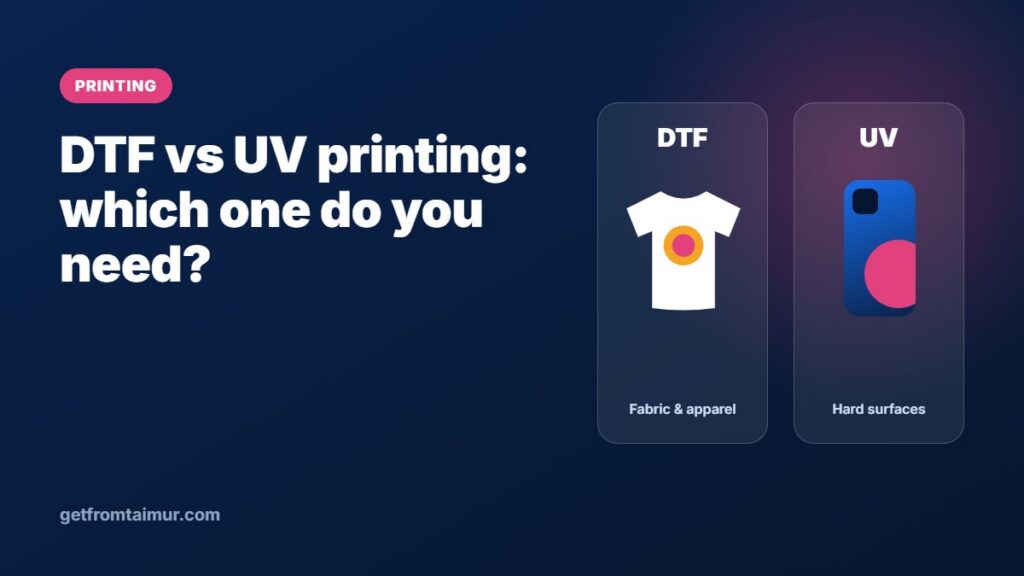
If you are launching merchandise, branded gifts or a print-on-demand line, you will quickly hear about two methods: DTF and UV printing. Both produce sharp, full-colour results, but they are designed for different surfaces. Choosing the right one saves money and gives you a better product.
What is DTF printing?
DTF stands for Direct to Film. The design is printed onto a special PET film, coated with an adhesive powder, cured, and then heat-pressed onto the item. The film peels away, leaving the print bonded to the fabric.
Best for
- T-shirts, hoodies and sweatshirts
- Tote bags, caps and other textiles
- Cotton, polyester and many blends — light or dark colours
Why businesses like DTF
- Full-colour designs with fine detail and gradients
- Works on dark garments without a separate screen for each colour
- Cost-effective for small runs and one-off designs
- Soft, flexible prints that hold up well in the wash when applied correctly
What is UV printing?
UV printing uses inks that are cured instantly by ultraviolet light as they are printed. Because the ink hardens on the surface, it can be printed directly onto rigid materials — and can even be layered to create a raised, textured effect.
Best for
- Phone cases, pens, USB drives and promotional items
- Acrylic, wood, metal, glass and plastic signs
- Stickers, labels and packaging
- Awards, plaques and display pieces
Why businesses like UV printing
- Prints directly on hard surfaces — no transfer step
- Vivid colours and crisp text, including white ink on clear materials
- Instant curing means fast turnaround
- Optional raised or gloss effects for a premium feel
DTF vs UV at a glance
| DTF printing | UV printing | |
|---|---|---|
| Main materials | Fabric and textiles | Hard and flat surfaces |
| Process | Print on film, then heat-press | Print directly, cure with UV light |
| Typical products | T-shirts, hoodies, tote bags, caps | Phone cases, signs, stickers, gifts |
| Small runs | Very suitable | Very suitable |
| Feel | Soft, flexible print | Hard, can be raised or glossy |
How to choose
The simplest rule: if it is fabric, choose DTF; if it is a hard surface, choose UV. Many brands use both — DTF for their apparel line and UV for stickers, packaging and promotional items.
Preparing your artwork
- Supply high-resolution files (vector or 300 DPI at print size)
- Use a transparent background for DTF designs
- Convert text to outlines so fonts print correctly
- Ask for a sample before ordering a large batch
Explore our print-on-demand services — DTF, UV, T-shirt and sticker printing and laser cutting — or request a printing quote.